




.jpg)
Artificial artist, or artificial plagiarist?
AI artwork is going mainstream, but it’s doing so off the back of human artists.
.jpeg)
AI artwork is going mainstream, but it’s doing so off the back of human artists.
What’s happening?
In the last few months, the creative artificial intelligence systems that I wrote about back in 2021 have traded the comfort and anonymity of universities, labs and Big Tech data centres for the bright lights of social media and the scrutiny of the mainstream press.
By now you will have seen friends, celebrities and “influencers” swap their traditional profile photos for what look like custom, contemporary portraits, possibly of them wearing a space-suit. Don’t be fooled. These people have not commissioned an artist to capture their essence on canvas (or in pixels). They have instead bought an app, handed an AI a dozen or so images of themselves, selected some themes and waited a minute or two, with some fairly spectacular results:
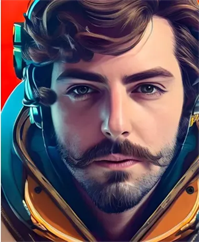
This image was created with Lensa, which rapidly climbed to the top of the Apple app store within days of its release late last year.
The systems that create these images, like Lensa or Midjourney, are called GANs, or “Generative Adversarial Networks”. In a nutshell, one AI (the “discriminator”) teaches itself what real art looks like, having been fed massive amounts of data consisting of images and labels explaining what's in the image. A second AI (the “generator”) creates random images that are sent to the discriminator, which determines whether or not they look like a real, human-produced image. Images that don’t pass muster are sent back with a realness score and the generator tries again. This happens over and over until the generator produces an image that the discriminator believes is real.
Why is it important?
Every single part of this is worthy of a deep dive, but our concern (as technology and IP lawyers) is with the data sets used to train the discriminators. Machine learning (the concept underpinning all modern AI) relies on vast amounts of data, frequently served up in the form of datasets comprised of information “scraped” from the internet by “bots” (automated programs designed to carry out a specific task).
Midjourney, for instance, (along with its competitors like DALL-E and Stable Diffusion) has been trained on a dataset called LAION-5B. This is an openly accessible image/text database that contains URLs pointing to approximately 5.85 billion images and their associated captions/descriptions. At no point has LAION, the dataset’s compiler (a non-profit organisation with the aim of making it easier for the general public to research and develop machine learning models), asked the creators or copyright holders of the scraped images for permission. And herein lies the problem.
From a pure copyright law perspective, LAION has an argument that they haven’t done anything wrong (although this is going to be tested soon – as we’ll come to). Almost all global copyright rules provide for a certain amount of “fair use”, and it is arguable that compiling a dataset for educational and research purposes is “fair”. In LAION’s case, it is unclear whether they would even be considered to have used the images at all, as the dataset they compiled just contains the URLs (the web addresses where the images can be found).
Furthermore, Midjourney and the like no longer need to rely on the dataset. The AIs have been trained, and don’t need to directly reference the images. Much like how I don’t need to reference an annotated picture of a 747 to know when I’m looking at a 747, Midjourney no longer needs to reference existing images to create new ones. If I ask it to create a “mid-century home in a lush valley with gravel driveway and a BMW E9”, it can create an entirely original image in a few seconds without copying an existing one:

Car nerds among you will know that that is most definitely not an E9, but it captures the essence of one, much like if someone tried to draw one from memory.
However, leaving aside technical arguments, these systems represent a major challenge to the fundamental purpose of copyright. Put simply, copyright laws recognise the value to society of creative output, and grant a creator the monopoly over their work, allowing them to monetise it and protect it from theft, derogatory treatment and misattribution. But Midjourney can take an artist’s style (provided they were included in the training dataset) and create a brand new image in seconds. Possibly one that the artist would not want to be associated with. I asked Midjourney to draw Joseph Stalin in the style of the legendary Jack Kirby (I intentionally chose an artist who isn’t with us anymore) and it made these in about 15 seconds:
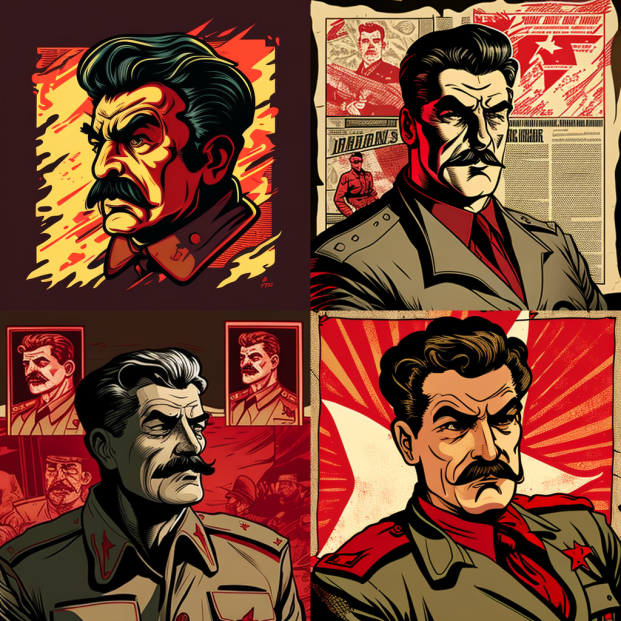
Those will look pretty familiar if you have looked at a comic book in last 50 years, but not exactly Mr Kirby’s usual subject matter (such as Captain America)!
Web cartoonist Sarah Andersen (of Sarah’s Scribbles) recently wrote in the New York Times about her struggles with her work being appropriated, and the ease with which AI image generators allow this to happen. It started with crudely photoshopped images swapping out the speech bubbles, but with these new services, entirely new frames can be generated using Sarah’s distinctive, black-and-white style. Her work was included in the LAION-5B dataset without her knowledge or permission.
The implications of this are profound, not only from an artistic integrity standpoint, but from a commercial one too. Where an artist with a reasonable online profile might have previously been commissioned to create a work, the potential customer can now, for a few bucks (or even a free trial) have a machine create a specific work “in the style of” the artist of their choosing. This has the potential to seriously dent the earnings of an entire industry. Add to this the implications of a world in which the quintessentially human practice of creating and consuming art is diluted by a glut of soulless, AI-created works, and the fun new apps start to look a little dystopian.
Services in this insight
From Hertzian waves to hyperlinks – What the BSA’s online decision means for your business
Space Law in New Zealand — Signals from the ground
Cyber security changes flagged for New Zealand
The four Cs of successful fintech partnerships
New rule 3A introduced to the Biometric Processing Privacy Code
IPP3A is nearly in force – What agencies need to know
OPC shifts public enquiries online – What agencies should do now
AI as a confidante? Legal privilege and the ever-increasing use of AI
New Therapeutic and Health Advertising Code – What you need to know
Building blocks of trade mark law: New Zealand approach to "use as a trade mark" now compatible with Australia
Consumer law update 2025
Open banking launches in New Zealand
Is fair something to fear? The Government announces beefed-up Fair Trading Act
Is it fair? Lessons from Bartz v Anthropic and Kadrey v Meta
Open banking almost live
Why New Zealand businesses should care about the EU Data Act
Product labelling changes flagged for New Zealand
Biometric Processing Privacy Code 2025 introduced to New Zealand
Open banking regulations released for consultation
Ten tips for buy-side M&A success
A recipe for disaster – Is caramel a copyright work?
Becoming a Globally Renowned Fintech Nation (and how regulation can light the path)
Important changes made to the Privacy Act
New Zealand may ban social media for young users
Customer and Product Data Act update – Open banking officially on the way
Tips from the trenches – Your AI policy cheat sheet
Significant regulatory reform proposed for New Zealand media
Security guidance released for emerging tech companies
Customer and Product Data Bill – Select Committee reports back
Consumer law update 2024
New Zealand’s Artist Resale Royalty is ready to go
The shape of coffee – “Moccona” vs “Vittoria”
New Zealand’s Copyright Act gets a sense of humour
WIPO’s traditional knowledge treaty is adopted
Doing business in the Middle East
AI and advertising – What producers need to know
Seven contract clauses every freelancer needs
Baby Reindeer – When truth is stranger than fiction?
Our comments on the Biometric Processing Privacy Code
Therapeutic Products Act to be repealed this year
Is End-to-End to end?
Geographical indications – Changes uncorked by the EU-NZ Fair Trade Agreement
Lawyers and Generative AI – New NZ Law Society guidance released
Facing the future – A biometrics code of practice for New Zealand?
Deepfakes and style mimicking – Should New Zealand adopt a right of publicity?
Five Eyes release the Five Principles to Secure Innovation
The copyright conundrum with generative AI
Innovate at the speed of trust – Privacy Commissioner releases new guidance on artificial intelligence tools
Political advertising on social media: sludge or copyright quagmire?
Privacy Amendment Bill introduced to Parliament
New Data Privacy Framework: Meta gets a lifeline
The long and winding road to royalties
Implications of the Supreme Court’s “new debt” approach in Mainzeal
EU gets closer to AI laws
UK Supreme Court puts Quincecare ‘duty’ back in its box
A Deep Dive into The Customer and Product Data Bill
Searching for a shield: Meta’s €1.2 billion fine and international transfers in the age of Big Data
New NZ-UK Free Trade Agreement signals tech, media and IP law changes
Ditch the fax! Tips for building a tech-savvy law firm
The Incorporated Societies Act 2022 – what you need to know for your society
Common myths about copyright online
Artificial artist, or artificial plagiarist?
Big boost to gaming
Is your product “AI powered”?
The latest on New Zealand’s Consumer Data Right
Space Law in New Zealand
You Cannot Defame the Dead or Can You? Tikanga Māori and NZ Defamation Law
Open Banking is coming – through the Consumer Data Right
Massive SEC Fines for Companies Using Text and Instant Messaging
One Act to Rule Them All
A Legal Guide to Kicking SaaS
Potential changes to the Privacy Act 2020
NZ's Social Media "Code of Practice" Launched
Are you being unfair?
Are you legal?
Power Up 2022
A new Companies Office levy is one step closer
Has Paramount Pictures gone maverick?
From Russia with love: The ‘other’ Russian conflict targeting intellectual property owners
I'm back, baby
Retail Payment System Act 2022 now in force
Paying the price for getting privacy wrong
Can AI be an inventor?
Finfluencer Crackdown
TIN Fintech Insights Report Launch
Britain seeks to regulate 'Big Tech'
Disclosure of personal information - how to, not don't do
The Spice May Flow, But The Copyright Doesn’t
Sound Recording Ownership (Taylor's Version)
The Lowdown (and Lockdown) on Summer Clerkships
Building Blocks of Trust
Firm News | Legal Rankings
Buy Now, Regulate Soon
Ten simple things
Funding the Future
Cyber Security for Start-ups
Fit for purchase
The Screen Industry Workers Bill
UK/New Zealand Trade Deal Takes Flight
Palmer v Alalääkkölä
Other articles you
might like
Negotiating a fintech partnership agreement is not a zero sum game.
New rule 3A means individuals must be notified about indirect collection under the Biometric Processing Privacy Code 2025.

%20(2).jpg)
The official commencement of open banking in New Zealand is a significant milestone for the local industry.