


.webp)

.webp)
%20(1).jpg)
.webp)
.jpg)
The copyright conundrum with generative AI
Over the last year, a huge number of generative AI lawsuits have been launched against developers, arguing that their algorithms rely on copyright infringement on an unprecedented scale and their outputs should not attract copyright protection.

Image: "Théâtre D'Opéra Spatial" (2022)Colorado State Fair art prize winner: Jason Allen (created by Midjourney)
Which is it:
Copyright infringement on an unprecedented scale and an existential threat to the artists, authors, musicians and software developers whose work it was trained on, which society should avoid rewarding with copyright protection?
Or just another useful creative tool for humans to use and no different to the fuss made about cameras in the late 1880s?
In 1884, a photograph of Oscar Wilde caused a stir in copyright law when a defendant (who had copied it without permission) argued that photographs should not attract copyright protection, because they have no human author. The photographer does not create the resulting image, it was argued: the camera does. All the photographer does is press the button. The Court disagreed, due to the level of creative intellectual control exercised by the photographer over the resulting image. Generative AI enthusiasts argue that generative AI is no different to works produced by a camera - the user inserting the prompt is like the photographer pressing the button - and its output should attract copyright in much the same way. It is just another useful creative tool for humans to use, they say.
But many artists, writers, code developers and musicians disagree.
Over the last year, a tidal wave of generative AI lawsuits have been launched against companies including Microsoft, GitHub, Meta, Stability AI, Open AI, Midjourney Inc and DeviantArt Inc, arguing that AI algorithms such as Stable Diffusion, Midjourney, Copilot, Codex, DreamUp, DreamStudio, LLaMA, GPT 3.5 and GPT 4 rely on copyright infringement on an unprecedented scale and threaten to decimate the creative professions of the authors whose works they were trained on. While massively popular, they are also massively illegal, it is claimed. Some are calling it “The Napster of the 2020s”.
These lawsuits allege that copyright infringement problems arise at two different stages: the initial training data input stage, and the final output stage.
The Training Input Issue
Generative AI algorithms that are trained on publicly available information (rather than proprietary datasets) are generally trained by scraping (i.e., copying) existing data inputs or content, such as books, artistic works, music and code. If the training data happens to be a copyright protected work owned by someone else, then (absent an available defence) this scraping would appear to amount to copyright infringement.
Generative AI trainers typically rely on the defence of “fair use” (fair dealing, in New Zealand) and specific text and data mining exceptions, which permit the copying of protected works for certain non-competitive purposes. In other words, the use must not compete with the purpose of the original author. These defences often require the use to be non-commercial, which makes them particularly appropriate for researchers at universities, and non-profits. The potential problem arises when these non-commercial entities license the resulting trained algorithm to commercial entities, which then charge customers fees for the creation of outputs. Those outputs arguably compete with the original content that the algorithm was trained on. The use of these defences by universities and non-profits to create algorithms which are then passed on to commercial entities (which ultimately compete with the original author of the training data) is a practice known as “data laundering”.
The US Supreme Court (USSC) recently weighed in on the limits of the fair use defence in the Warhol case (Andy Warhol Foundation v Goldsmith (May 2023) (SC)). Andy Warhol had copied photographs of musical artist Prince (which had originally been used to accompany an article about Prince) to make a series of silkscreen prints. Only one copy had been licensed by the photographer. Unbeknownst to her, Warhol had made several (unlicensed) copies, one of which was later used to accompany a magazine article about Prince upon his death. As the purpose of Warhol’s copy competed with the purpose of the original photograph, the USSC held this use was not transformative, and therefore not fair use. By contrast, Warhol’s (Campbells) canned soup series had been made, not for the purpose of selling soup, but for the arguably opposite purpose of critiquing consumerism. This purpose did not compete with the Campbells artwork and did qualify as fair use.
The Output Issue
The elements required to establish copyright infringement are:
- causal connection (including the ability to copy);
- the taking of a substantial part of the original; and
- objective similarity between the original work and the “new” work. Courts have said: “a copy is a copy if it looks like a copy”. Or in music cases: “a copy is a copy if it sounds like a copy” (Eight Mile Style LLC v New Zealand National Party [2017] NZHC 2603).
Many infringements do not even require any form of “wrongful” intention: it will infringe copyright in the original work to copy it, to issue copies of it to the public, or to perform it in public, even if you do not know that an infringement has occurred, although having such knowledge will increase the damages awarded. Copyright infringement has been established for subconscious and entirely unintentional copying of musical works (EMI Songs Australia Pty Limited v Larrikin Music Publishing Pty Limited [2011] FCAFC 47). Compounding this issue is the fact that, in some jurisdictions (such as the USA) it will infringe copyright to make a “derivative work”, being a new work that is identifiably “based on” or adapted from the original.
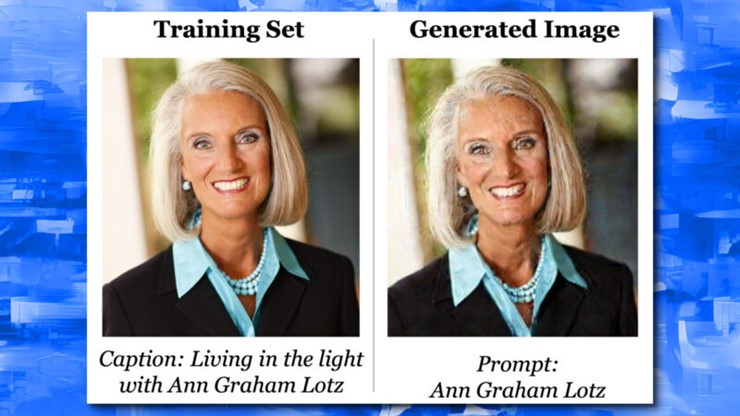
Recent generative AI lawsuits claim the outputs of AI algorithms trained on the plaintiffs’ works directly compete with their works and threaten to put them out of business. The plaintiffs allege these outputs are illegal copies of the plaintiffs’ works, or derivative works made from them. And there is some scientific support for these claims. AI researchers (Somepalli et al, 2022) suggest that while generative AI algorithms do not store copies of their training data, certain generative AI models can memorise that training data, which can result in the output looking very much like a copy of the training data, such as in the following example:
And this presents a risk for users of generative AI algorithms trained on copyright works without permission. Works that you use in your business may end up not only not protectable from use by third parties (most jurisdictions still require a human author for copyright subsistence - New Zealand and the UK are currently outliers on this front and New Zealand’s approach to AI copyright subsistence is currently under review) but also infringing the copyright of the authors of the training data.
Where to from here?
Until the outcome of the current suite of AI lawsuits is known, this issue will continue to present:
- a substantial risk to users of the generative AI featuring in these cases;
- a considerable risk to the developers of the generative AI models concerned; and
- a continuing concern to the authors who attempt to earn a living from the copyright granted to their works.
For these reasons, “legal” training datasets are now being created to train AI, comprising solely of public domain and licensed works, or training data that is proprietary to the generative AI tool developers, and some AI developers (such as Microsoft) are even providing indemnities to protect users from the risk of third party infringement claims.
If you have questions about your business’ development or use of generative AI or the steps you can take to protect your own copyright works, please get in touch with one of our experts.
Services in this insight

When software stalls the starting grid – Why testing matters
Open banking standards to be managed by MBIE
Not fooling around – "The Meme Bill" approaches second reading, but how will it actually work here?
"Now is the time to act" – Reserve Bank seeks feedback on modernising New Zealand’s retail payment system
Global AI shut down – What the United States export controls on AI mean for New Zealand businesses
Fair Trading Act reform – More agile product safety standards
Fair Trading Act reform – New "safe harbour" for suspected scam activity
Fair Trading Act reform – Changes will increase governance risk for business
New Zealand’s online gambling laws get a shake up
Consultation opens on New Zealand's payment services regulation
Modern slavery regulation on the way – Is your business ready?
From Hertzian waves to hyperlinks – What the BSA’s online decision means for your business
Space Law in New Zealand — Signals from the ground
Cyber security changes flagged for New Zealand
The four Cs of successful fintech partnerships
New rule 3A introduced to the Biometric Processing Privacy Code
IPP3A is nearly in force – What agencies need to know
OPC shifts public enquiries online – What agencies should do now
AI as a confidante? Legal privilege and the ever-increasing use of AI
New Therapeutic and Health Advertising Code – What you need to know
Building blocks of trade mark law: New Zealand approach to "use as a trade mark" now compatible with Australia
Consumer law update 2025
Open banking launches in New Zealand
Is fair something to fear? The Government announces beefed-up Fair Trading Act
Is it fair? Lessons from Bartz v Anthropic and Kadrey v Meta
Open banking almost live
Why New Zealand businesses should care about the EU Data Act
Product labelling changes flagged for New Zealand
Biometric Processing Privacy Code 2025 introduced to New Zealand
Open banking regulations released for consultation
Ten tips for buy-side M&A success
A recipe for disaster – Is caramel a copyright work?
Becoming a Globally Renowned Fintech Nation (and how regulation can light the path)
Important changes made to the Privacy Act
New Zealand may ban social media for young users
Customer and Product Data Act update – Open banking officially on the way
Tips from the trenches – Your AI policy cheat sheet
Significant regulatory reform proposed for New Zealand media
Security guidance released for emerging tech companies
Customer and Product Data Bill – Select Committee reports back
Consumer law update 2024
New Zealand’s Artist Resale Royalty is ready to go
The shape of coffee – “Moccona” vs “Vittoria”
New Zealand’s Copyright Act gets a sense of humour
WIPO’s traditional knowledge treaty is adopted
Doing business in the Middle East
AI and advertising – What producers need to know
Seven contract clauses every freelancer needs
Baby Reindeer – When truth is stranger than fiction?
Our comments on the Biometric Processing Privacy Code
Therapeutic Products Act to be repealed this year
Is End-to-End to end?
Geographical indications – Changes uncorked by the EU-NZ Fair Trade Agreement
Lawyers and Generative AI – New NZ Law Society guidance released
Facing the future – A biometrics code of practice for New Zealand?
Deepfakes and style mimicking – Should New Zealand adopt a right of publicity?
Five Eyes release the Five Principles to Secure Innovation
The copyright conundrum with generative AI
Innovate at the speed of trust – Privacy Commissioner releases new guidance on artificial intelligence tools
Political advertising on social media: sludge or copyright quagmire?
Privacy Amendment Bill introduced to Parliament
New Data Privacy Framework: Meta gets a lifeline
The long and winding road to royalties
Implications of the Supreme Court’s “new debt” approach in Mainzeal
EU gets closer to AI laws
UK Supreme Court puts Quincecare ‘duty’ back in its box
A Deep Dive into The Customer and Product Data Bill
Searching for a shield: Meta’s €1.2 billion fine and international transfers in the age of Big Data
New NZ-UK Free Trade Agreement signals tech, media and IP law changes
Ditch the fax! Tips for building a tech-savvy law firm
The Incorporated Societies Act 2022 – what you need to know for your society
Common myths about copyright online
Artificial artist, or artificial plagiarist?
Big boost to gaming
Is your product “AI powered”?
The latest on New Zealand’s Consumer Data Right
Space Law in New Zealand
You Cannot Defame the Dead or Can You? Tikanga Māori and NZ Defamation Law
Open Banking is coming – through the Consumer Data Right
Massive SEC Fines for Companies Using Text and Instant Messaging
One Act to Rule Them All
A Legal Guide to Kicking SaaS
Potential changes to the Privacy Act 2020
NZ's Social Media "Code of Practice" Launched
Are you being unfair?
Are you legal?
Power Up 2022
A new Companies Office levy is one step closer
Has Paramount Pictures gone maverick?
From Russia with love: The ‘other’ Russian conflict targeting intellectual property owners
I'm back, baby
Retail Payment System Act 2022 now in force
Paying the price for getting privacy wrong
Can AI be an inventor?
Finfluencer Crackdown
TIN Fintech Insights Report Launch
Britain seeks to regulate 'Big Tech'
Disclosure of personal information - how to, not don't do
The Spice May Flow, But The Copyright Doesn’t
Sound Recording Ownership (Taylor's Version)
Other articles you
might like
.webp)
New Zealand is edging closer to a parody and satire exception to copyright infringement.



A recent Court of Appeal decision provides long awaited clarity for businesses on the lawful use of another party’s trade mark in New Zealand.

.jpg)
Two contrasting court judgments have been released on whether it is legal to train LLMs using copyright protected works.